Sunday, May 3, 2009

Past Exploration of the Red Planet, by Sean Madden


When people talk about the space race of the late 1950s and 1960s, most people assume that this refers to Americans and Soviets both seeking to explore the Moon. Surprisingly, space missions to Mars have been attempted since 1960, although there were many failures before the success of the American satellite Mariner 4 in 1964. It also may be surprising to hear that the first six missions weren’t even affiliated with the U.S.—instead they were Soviet spacecraft. Despite the advancement in technology and goals of missions to Mars over the last 50 years or so, there still has yet to be a manned mission to the red planet.

In October of 1960, the Soviets began the Marsnik program with the goal of having a spacecraft study the space between Earth and Mars, study Mars itself and return images via a flyby. Unfortunately, both the Marsnik 1 and Marsnik 2 failed to make it to Earth’s orbit. The Soviets didn’t have much more success with missions to Mars later in 1962 or 1964 with the beginning of the Zond program. Despite the lack of successful missions, the USSR wasn’t deterred and actually, before any success with flyby missions to Mars, they attempted to land a spaceship on Mars in late 1962-early 1963. The Sputnik 24 only made it to Earth’s orbit and then broke apart as it attempted to re-enter Earth’s atmosphere. Overall, it is important to note that there is slight uncertainty with the information about the former Soviet spacecraft because of course, this was the space race during the Cold War and some information from that time period can be nebulous.

The US involvement with Mars began with the very successful Mariner program that spawned a total of six missions to Mars yielding the first successful flyby of Mars and the first successful orbit of the nearby planet. Between 1962 and 1973, NASA’s Jet Propulsion Laboratory built 10 Mariner spacecraft to explore the inner solar system. The first two launches in the program related to Mars were two identical spacecraft, Mariner 3 and Mariner 4, that were designed to be the first satellites to fly by Mars and take pictures of its surface. Mariner 3 failed in its mission to get to Mars, but Mariner 4 was successful in being the first object to complete a flyby of Mars and collect close-up photographs of Mars. This is pretty remarkable considering that we wouldn’t even land on the moon for four more years. Mariner 6 and Mariner 7 were launched in February and March of 1969. They were able to analyze the atmosphere and surface of Mars using sensors and relayed hundreds of pictures back to Earth. These missions were also important in debunking the myth that Mars contained canals as was believed for much of the 1800s. The final two missions to Mars in the Mariner program were launched in May 1971 and while Mariner 8 failed to launch, Mariner 9 succeeded in functioning in Mars’ orbit for nearly a year. The latter spacecraft completely revised the perception of Mars by revealing enormous volcanoes, canyons and evidence of ancient riverbeds. It was able to photomap 100% of the planet’s surface and achieve the first close-up pictures of Mars’ two moons—Phobos and Deimos. The timing of these accomplishments was impeccable, because not even a month later, the Soviet Mars program achieved a successful orbit of Mars.

The Soviet Mars and Phobos programs were marked with mostly failure, but achieved a lot of success especially with the Mars 3 mission. After the failure of the first two Mars missions, Mars 3 was successful in being the first Soviet craft to gather data in Mars’ orbit and the first mission to successfully land on the Martian surface. The orbiter sent back about eight months of data from December 1971 to August 1972 about things ranging from the topography of the surface to Mars’ gravity. The lander was not so successful and only transmitted about 15-20 seconds of data. The Mars program did have four more missions (Mars 4-7), but these had very minor impact in advancing our knowledge about the red planet. The following Phobos program produced two missions toward the end of the USSR in 1988. They were intended to observe Mars as well as its moon Phobos, but were mostly unsuccessful missions.

On the American side, the Viking program produced arguably the greatest success of any missions to Mars to date. The two missions had vehicles that were composed of two main parts, an orbiter and a lander. They were launched successively in August and September of 1975 and arriving at Mars in June and August of the following year. In addition to performing their own scientific experiments, the orbiters helped to communicate with the landers and locate good landing sites. One of the main scientific objectives of the missions was to perform biological experiments to see if any signs of life existed in the soil of Mars. Although there is still some ongoing debate, the general agreement is that the results showed no evidence of microbial life on Mars.

In the post-Cold War era, the push for missions to Mars has remained strong with the U.S. leading the way. Although other nations like the U.K., Japan and Russia have attempted missions, the only real success came with the Mars Global Surveyor and the Mars Pathfinder. The Mars Global Surveyor marked the U.S. return to Mars after a long absence and was launched in November 1996. Among other things, probably the mission’s greatest contribution was photos of craters that appear to the presence of water at some point on Mars. The Mars Pathfinder was launched in December 1996 and was intended to analyze the environment of Mars. It was significant in being the first of a number of missions to Mars that included rovers that could better analyze the surface of Mars. Another important aspect of this mission was to prove that NASA could engage in low-cost practices. Although NASA at times has had struggles with its budget, it has produced a number of successful missions with more missions set to launch in the near future. Today, the U.S. has many ongoing missions to Mars including the Spirit and Opportunity rovers that have far surpassed expectations.
The actual “getting” to Mars: A survey of Propulsion techniques, by Charles Stone

Before going to Mars, however we have to consider the actual propulsion techniques available to humans for travel. Certain types of propulsion are more readily available while others are far off. Each of these has benefits but we will have to be careful in choosing the one that will get us the over 78 million kilometers to Mars (1).


(The old space shuttle) (2)

The Old Stand-by

There is of course the existing material that we have: chemical propulsion. Under this method the reaction between hydrogen and oxygen creates heat which then pushes gas out the rocket nozzle otherwise known as thrust (3) Chemical rocket engines are readily available meaning if we wanted to leave now, we use them. The only problem with this method of propulsion is its speed and weight. There are simply too many limitations which we have discovered with chemical engines (although for many of these other technologies, we don’t as yet know their limitations). In the chemical-rocket situation it’s a simple question of specific impulse (Isp), weight, and thrust to weight ratio(4). Isp is a ratio between thrust and the weight consumption rate of propellant which boils down to how long the engine will provide force to gain a certain momentum (5). In chemical rockets this is unfortunately short lasting perhaps 500s. Thankfully, the thrust to weight ratio is high at 50-75 so we got around the short Isp by using stages and jettisoning the useless empty stages (6). That may seem like a lot of technical-language but it simply means that chemical rockets need a lot of fuel to change momentum at all. This seems slightly unfeasible however, for a long trip in which you would still rely on these short burn, heavy, and jettisoning rockets. The prediction is that under this system it would take six months to reach Mars and it would have to wait 18 months until the return six months journey could be made. That would be a 2.5 year round trip (7).


(8)


Nuclear Propulsion

Research into this technology was first pioneered during the Cold War by both the U.S.A. and the Soviet Union (9). The first way a nuclear propulsion engine would work is to have a reactor with a solid core generating heat. This heat is then radiated to a separate gas propellant which when heated ionizes. When this ionized gas is pushed out of a magnetic nozzle, we achieve forward thrust (10). The other method uses a gas core which is radiated through a tube to heat the gas surrounding it to an even higher temperature (11). The Isp on a solid core Nuclear propulsion system is 1000s (12). The thrust to weight ratio is also 1-20 meaning we can go farther, faster, with much less fuel (13). In comparison to chemical rockets they take a lot less fuel to change the momentum and thus it is a more efficient way to travel. The nuclear propulsion does have one major setback: launching a nuclear rocket in earth orbit is probably not the best thing for the people down below (14).


(solar sail concept) (15)

Forget the Engines: Solar Sails

Of course, if conventional and pseudo-conventional (nuclear power) rockets are too tough why not just get rid of them altogether? Solar sails attempt to do that. The concept is actually much older then many would believe. During his observations of a comet, Johannes Kepler believed that what was moving the comet was actually solar winds and hypothesized that the best way for humans to move through space would be to do likewise (16). Kepler had the wrong source but the right idea and today there have been several developments in solar sails which are powered by light itself (17). Modern solar sails use a very thing sheet of aluminum reinforced Mylar to reflect photons as they hit the sail (18). The photons released by the sun push the sail forward as they strike it and reflect back (19). The solar sail powered ship would eventually reach 56 mi/sec (200,000 mph) or 10 times faster then the Space Shuttle’s orbital velocity (20). The only problems with solar sails are that you have to use conventional rockets to get them into space and that little word: eventually. Acceleration at the beginning of the trip is very slow so it might not be best for a mission to Mars (21). Regardless, the technology is already being used for deep-space missions, by Japan as of 2004, and by NASA with its nano-sail as of last summer which eventually failed but still proved the concept (22).


(concept of mag-beam propulsion)(23)


The Round Trip in 90 days on plasma

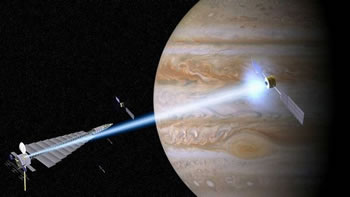
The Magnetized-beam plasma propulsion system is a new idea from the University of Washington’s professor Robert Winglee (24). Basically it places a space station above earth which generates plasma, magnetizes it, and then has it interact with a ship with magnetized sails pushing it forward(25). The larger the nozzle for the ions the greater the thrust and Winglee believes one 32 meters wide could propel a craft at 11.7 km/s (26,000 mph) (26). This is slower then the top speed of the solar sail but then again it will go at this speed throughout most of the journey. Under this speed it would take 76 days to get to Mars but they believe by increasing the stream of plasma they can bring that down to a 90 day round trip (27). The problem is this is still very experimental and the ship itself wouldn’t carry much in the way of propulsion itself so it would need another such station around Mars to slow it down and pinpoint accuracy to put it inline with that station (28).

(concept of anti-matter to matter collision propelled spaceship) (29)


Enterprise, do you read me?

Yes, there is always the sci-fi favorite anti-matter. Anti-matter is what it says it is, the opposite of matter. When the two are forced together, they annihilate each other and create a massive amount of energy (30). Such spaceships using an idea similar to that of Nuclear propulsion, according to a Penn State research team, would have an Isp of 100,000-1,000,000 seconds (31). Anti-matter would be an incredibly efficient way to explore space except for one glaring problem: anti-matter. It seems we just don’t have enough and it is really expensive at 62.5 trillion dollars a gram (32).


So how are we getting there?

What is the best way to Mars, and the corollary, what is the fastest and most efficient? In this writer’s opinion, chemical propulsion is too ineffective for long range transportation. It is still perhaps the best way to get into orbit (not due to effectiveness but more so due to the lack of extremely volatile or radioactive byproducts), but not to get to Mars. Solar sails are perhaps the most efficient but they take too long to reach their max speed. The technologies which seem most viable at this point are further developments in nuclear propulsion and magnetized-beam plasma propulsion.


Endnotes

(1) J. Bennett, M. Donahue, N. Schneider, and Mark Voit, The Solar System, (San Fransisco: Pearson Education), A-15.
(2) “Space Shuttle: Image Gallery,” NASA, http://www.nasa.gov/mission_pages/shuttle/shuttlemissions/sts125/multimedia/gallery/gallery-index.html, 04/07/2009.

(3) Bromley, Blair P., “Nuclear Propulsion: Getting More Miles per Gallon,” Space Exploration, Astrodigital, 2001, http://www.astrodigital.org/space/nuclear.html, 04/07/2009.

(4) Bromley, Blair P., “Nuclear Propulsion: Getting More Miles per Gallon,” Space Exploration, Astrodigital, 2001, http://www.astrodigital.org/space/nuclear.html, 04/07/2009.

(5) Bromley, Blair P., “Nuclear Propulsion: Getting More Miles per Gallon,” Space Exploration, Astrodigital, 2001, http://www.astrodigital.org/space/nuclear.html, 04/07/2009.

(6) Bromley, Blair P., “Nuclear Propulsion: Getting More Miles per Gallon,” Space Exploration, Astrodigital, 2001, http://www.astrodigital.org/space/nuclear.html, 04/07/2009.

(7) Behar, Michael, “5 ways to get to Mars” Wired: Issue 12.12, December 2004, http://www.wired.com/wired/archive/12.12/mars.html, 04/07/2009.

(8) Babula, Maria, “Nuclear Thermal Rocket Propulsion,” Space Propulsion and Mission Analysis Office, NASA, http://trajectory.grc.nasa.gov/projects/ntp/, 04/07/2009.

(9) Bromley, Blair P., “Nuclear Propulsion: Getting More Miles per Gallon,” Space Exploration, Astrodigital, 2001, http://www.astrodigital.org/space/nuclear.html, 04/07/2009.

(10) Bromley, Blair P., “Nuclear Propulsion: Getting More Miles per Gallon,” Space Exploration, Astrodigital, 2001, http://www.astrodigital.org/space/nuclear.html, 04/07/2009.

(11) Bromley, Blair P., “Nuclear Propulsion: Getting More Miles per Gallon,” Space Exploration, Astrodigital, 2001, http://www.astrodigital.org/space/nuclear.html, 04/07/2009.

(12) Bromley, Blair P., “Nuclear Propulsion: Getting More Miles per Gallon,” Space Exploration, Astrodigital, 2001, http://www.astrodigital.org/space/nuclear.html, 04/07/2009.

(13) Bromley, Blair P., “Nuclear Propulsion: Getting More Miles per Gallon,” Space Exploration, Astrodigital, 2001, http://www.astrodigital.org/space/nuclear.html, 04/07/2009.

(14) Behar, Michael, “5 ways to get to Mars” Wired: Issue 12.12, December 2004, http://www.wired.com/wired/archive/12.12/mars.html, 04/07/2009.

(15) Coulter, Dauna, “A Brief History of Solar Sails” Science@NASA, NASA, 07/31/2008, http://science.nasa.gov/headlines/y2008/31jul_solarsails.htm, 04/07/2009.

(16) Bonsor, Kevin, “How Solar Sails Work,” How Stuff Works, Discovery Company, http://science.howstuffworks.com/solar-sail4.htm, 04/07/2009, pg. 2.


(17) Bonsor, Kevin, “How Solar Sails Work,” How Stuff Works, Discovery Company, http://science.howstuffworks.com/solar-sail4.htm, 04/07/2009, pg. 2.


(18) Bonsor, Kevin, “How Solar Sails Work,” How Stuff Works, Discovery Company, http://science.howstuffworks.com/solar-sail4.htm, 04/07/2009, pg. 3.


(19) Bonsor, Kevin, “How Solar Sails Work,” How Stuff Works, Discovery Company, http://science.howstuffworks.com/solar-sail4.htm, 04/07/2009, pg. 3.


(20) Bonsor, Kevin, “How Solar Sails Work,” How Stuff Works, Discovery Company, http://science.howstuffworks.com/solar-sail4.htm, 04/07/2009, pg. 5.


(21) “Solar Sails,” BBC Science and Nature: Space, http://www.bbc.co.uk/science/space/exploration/futurespaceflight/solarsails.shtml, 04/07/2009.

(22) Coulter, Dauna, “A Brief History of Solar Sails” Science@NASA, NASA, 07/31/2008, http://science.nasa.gov/headlines/y2008/31jul_solarsails.htm, 04/07/2009.

(23) Stricherz, Vince, “New propulsion concept could make possible 90-day round trip to the red planet” University of Washington News, University of Washington, 10/14/2004, http://www.uwnews.org/article.asp?articleID=5817, 04/07/2009.


(24) Stricherz, Vince, “New propulsion concept could make possible 90-day round trip to the red planet” University of Washington News, University of Washington, 10/14/2004, http://www.uwnews.org/article.asp?articleID=5817, 04/07/2009.


(25) Stricherz, Vince, “New propulsion concept could make possible 90-day round trip to the red planet” University of Washington News, University of Washington, 10/14/2004, http://www.uwnews.org/article.asp?articleID=5817, 04/07/2009.


(26) Stricherz, Vince, “New propulsion concept could make possible 90-day round trip to the red planet” University of Washington News, University of Washington, 10/14/2004, http://www.uwnews.org/article.asp?articleID=5817, 04/07/2009.


(27) Stricherz, Vince, “New propulsion concept could make possible 90-day round trip to the red planet” University of Washington News, University of Washington, 10/14/2004, http://www.uwnews.org/article.asp?articleID=5817, 04/07/2009.


(28) Stricherz, Vince, “New propulsion concept could make possible 90-day round trip to the red planet” University of Washington News, University of Washington, 10/14/2004, http://www.uwnews.org/article.asp?articleID=5817, 04/07/2009.

(29) Dooling, Dave, “Reaching for the stars: Scientists examine using antimatter and fusion to propel future spacecraft,” Science@NASA, NASA, 04/12/1999, http://science.nasa.gov/newhome/headlines/prop12apr99_1.htm, 04/07/2009.


(30) Dooling, Dave, “When Isaac met Albert,” NASA: Marshall Space Flight Center, http://science.nasa.gov/newhome/headlines/msad12nov97_1.htm, 04/07/2009.


(31) Dooling, Dave, “Reaching for the stars: Scientists examine using antimatter and fusion to propel future spacecraft,” Science@NASA, NASA, 04/12/1999, http://science.nasa.gov/newhome/headlines/prop12apr99_1.htm, 04/07/2009.


(32) Dooling, Dave, “Reaching for the stars: Scientists examine using antimatter and fusion to propel future spacecraft,” Science@NASA, NASA, 04/12/1999, http://science.nasa.gov/newhome/headlines/prop12apr99_1.htm, 04/07/2009.

Human Obstacles to Space Travel, by Jeremy Parker

There are many obstacles to making manned space travel to Mars a reality. We currently crawl through space at a measly 18,000 miles per hour making any but the closest planets and moons unrealistically distant for travel purposes. Space is a vast area but there is a lot of debris floating out there. There is a decent possibility of impact with foreign objects. Unfiltered solar radiation has the potential to quickly degrade high tech equipment necessary for the flight of spaceships. However, these problems occur in non-manned as well as manned travel. I will focus on the dangers of manned space travel on the human body and mind.

There are three major deterrents to long-term manned space travel concerning the human body and psyche. None of them have easy answers and each, by themselves, might be enough to shelve the idea of comprehensive space travel, even to a planet as close as Mars, for decades or even centuries. Colonization of a rock as distant as Mars is essentially impossible today. I will speak about the problems of bone loss due to lack of gravity, unfiltered radiation's effect on a living organism and the psychological effects of such a long trip cooped up with people you might not associate with if given the chance plus the isolation from anything or anyone new for months and years at a time.

Without gravity, bones, especially the lower extremities, atrophy as they are not needed to carry the weight of the human body. This process is called disuse osteoporosis. The lack of stress to the bones from the weight of a human being slows the formation of osteoblast cells which build bone. With the loss of the bone-building cells and the natural process of bones breaking down leads to the loss of mass. Most bones atrophy between one to one and one half percent per month in the emptiness of space. This may not sound too horrible at first glance but right now it would take approximately 15 months to reach Mars. Some bones would have lost 22.5% of their original mass. This, in effect, would equal the effects of growing up bed-ridden as an invalid from birth.

There is currently substantial research into countering the effects of disuse osteoporosis at NASA and certain health organizations. The consensus is that a specific diet mixed with pharmacological aids, such as certain hormones, and specialized exercise regimens may eventually be used to minimize bone loss in space travel, but it is clear they don't have the exact answer now.

Bone loss leads directly to discussion about the second major danger to human beings while traveling in space. Without an atmosphere filtering out radiation, like the Earth has, space ships would get a direct dose of many types of radiation. It is unclear the exact effects of these energies upon human bodies but it is likely many of them are severely damaging at the cellular level. A recent study on mice showed that mice receiving the equivalent of what a human would receive on a trip to Mars lost 39% of spongy bone tissue and as much as 64% connectivity of spongy bone tissue, which is in line with a diagnosis of osteoporosis. Add this loss due to disuse osteoporosis and the effects would be catastrophic.

It is believed among scientists that the radiation in space would likely mutate DNA in humans causing all kinds of cancers. It would cause cataracts in the eyes. It would cause loss of fertility in space travelers and genetic defects in their offspring.

This problem is not easily overcome. Shielding using water, hydrogen or plastics could help but the amount of radiation absorbed by a traveler would still be well above the recommended maximum by NASA's standards. Faster travel would help as there would be less time to absorb these particles. Certain drugs could also help mitigate the effects of radiation on the body. Many scientists believe that a certain amount of risk will always be inherent due to radiation no matter how many safety measures are taken unless we succeed at finding some previously unimagined breakthrough.

The third major obstacle to manned space flight to Mars is the least measurable. It is virtually impossible to study as it is mostly theoretical. There has been no 15 month space travel. Those that do go into space for any amount of time are the best and brightest and are specifically trained for the hazards of space, physical, physiological and psychological. Although this would not preclude them from developing the same problems as the general population it is probably not an ideal test group if we are going beyond travel and are thinking about colonization with a variety of people.

Psychologists have used somewhat similar cases to make hypotheses on the effects of space travel on the mind. Arctic research stations and submarines house people who are in a closed space for many months at a time. Typical responses to the stress of being so isolated in a confined space with a small number of people for an extended period of time are insomnia, anxiety and depression.

Living in such close quarters with people will magnify people's irritation levels at annoying mannerisms and habits. If they are already incompatible with each other the relationship could develop into disdain or even loathing. Living with these feelings about a person you must be with for months or years with no break is unhealthy and can lead to a lot of stress related disorders.

Another problem that has an effect on the mind of the traveler would likely be loss of motivation. Scientists have found that weightlessness of the human body causes a lack of vitality and an increase in fatigue causing lethargy and listlessness.

Keep in mind, these are just the effects observed on men and women that have passed rigorous psychological testing and are probably some of the most psychologically resilient people in the world. For the general public these issues would likely be extremely stressful and could lead to psychoses and neuroses in a portion of the population.

To me it is clear that the effects of space travel on human beings preclude us from comprehensive visits to even the closest planets and colonization of a planet such as Mars (even discounting the problems of terraforming such a place) would be virtually impossible at this time. Much research into propulsion, shielding, medicine and psychology is needed before even considering such a monumental journey.


References


Comins, Neal (2007). The hazards of space travel: A tourist's guide. Villard.

Hullander, Doug (2001, October 1). Space bones. Retrieved April 5, 2009, from Science@NASA Web site: HTTP://science.nasa.gov/headlines/y2001/ast01oct_1.htm


Lloyd, Robin (2006, July 18). Radiation and bone loss: Deep space mission concerns. Retrieved April 5, 2009, from Science.com Web site: http://www.space.com/scienceastronomy/060718_radiation_bones.html


Fornace, Albert J. (2008, April 16). Space radiation may cause prolonged cellular damage to astronauts. Retrieved April 5, 2009, from Science Daily Web site: http://www.sciencedaily.com/releases/2008/04/080415164332.htm


Edwards, Rob (2005). Cosmic rays may prevent long-haul space travel. Retrieved April 5, 2009, from NewScientist Web site: http://www.newscientist.com/article/dn7753-cosmic-rays-may-prevent-longhaul-space-travel.html


Atkinson , Nancy (2008, August 14). Research and technology to help psychological issues in space. Retrieved April 5, 2009, from Universe Today Web site: http://www.universetoday.com/2008/08/14/research-and-technology-to-help-psychological issues-of-space-travel/


Psychological effects of space travel. Retrieved April 5, 2009, from Astrobiology: The living universe Web site: http://library.thinkquest.org/C003763/index.php?page=adapt03

Blog: Water and Potential Life on Mars


Mars has been thought to have been cold, dry, and dead for billions of years. Mars’ past, however, reveals a much warmer climate with flowing rivers, even though its atmosphere today is too thin, allowing water to freeze or ultraviolet light to penetrate to the surface and boil it away as Hydrogen and Oxygen. There is evidence supporting this past, such as dry river beds and minerals on the surface that form in the presence of water. Additionally, recent observations and research reveal that Mars is not yet dead, but still active. There have been abundant methane emissions in the Martian atmosphere throughout the last several Mars years. By using telescopes with spectrometers, analysts have detected three areas where substantial amounts of methane have been absorbing reflected sunlight from Mars’ surface. These observations show that there are ongoing processes that release methane, especially because Mars’ thin atmosphere normally destroys it quickly. These processes can be attributed to one or both of the following: ongoing geological processes and microbial processes.

The geological approach claims that methane plumes are released due to geological processes similar to those on Earth. Mars does not have any currently known, active volcanoes. The possibility still exists, however. Thus, methane may be released through volcanic out-gassing. In this case, ground water, carbon dioxide, and Mars’ internal heat all factor together to create methane. Then, the methane can travel to the surface and be released through volcanic activities. However, other processes may be factors. The methane plumes observed are most substantial during the warm season and seem to cover areas where there is evidence of ancient ground ice or flowing water. Therefore, another possibility is that methane (similarly formed) is stored in ice “cages” under the surface. During the warm season, permafrost situated over fissures is heated. As the permafrost clears, stored methane can be released into the atmosphere through the openings fissures provide. Additionally, the surface above these ice “cages” may happen to be the areas where there is evidence for ancient ground ice or flowing water. From observations, some methane plumes also contained water vapor, supporting this claim. This fact, however, leads to the microbial approach on the methane emissions.

The microbial approach claims that many biological organisms release methane as they digest nutrients. On earth, microorganisms can thrive two to three kilometers beneath the surface where radiation can split water into Hydrogen and Oxygen. The microorganisms then use the Hydrogen for energy. Similarly, it is possible that there is subsurface liquid water under the Martian tundra. Microorganisms can then use the Hydrogen, split from water through radiation, in addition to subsurface carbon dioxide to thrive. The methane they release through digestion could be stored under the surface until fissures or volcanic out-gassing allows it to be released into the atmosphere. In addition, with such large amounts being released, these microbial processes may have been occurring for the past billions of years. Knowing that some of Earth’s earliest life forms created methane through carbon dioxide and Hydrogen, there is the potential for the beginnings of life on Mars as well.
Subsurface liquid water is essential for either of the two processes. There is some evidence pointing to the existence of some form of water on Mars, meaning that liquid water below the surface is quite reasonable. As stated before, there has been water vapor discovered in some of the methane plumes, suggesting subsurface water. In 1997, an image from a Mars Global Surveyor showed evidence of seepage features on the walls of a crater. The material in the crater’s gully could just be lava flows, but there is the possibility that the gullies hold ice water instead. Upwelling subsurface water would be a significant factor for potential life on Mars. The water would continually replenish the surface ice, and if the water held organic material or even microorganisms, there would be direct evidence for life in the ice. Then, drilling could be done well in advance of human missions in order to further the promotion of life on Mars. In addition, NASA’s Phoenix Lander has also identified water in a soil sample. There was evidence for ice water by earlier orbiters, as well as by the Phoenix while it was in orbit. However, the Phoenix was also able to land and take a soil sample that was two inches deep. The soil was frozen hard, but the Phoenix was able to warm up the sample and taste liquid water in it. The ice sample does create questions about the ice being able to thaw enough or hold the proper carbon-containing chemicals to support life, but it allows for a greater understanding of the Martian soil for future missions as well.

From the data on methane emissions to the data regarding water on Mars, one can believe that Mars is still active. Although the extent of this activity – whether geological, biological, or both – is unknown, these observations add to the knowledge of Mars. As time progresses, new technologies, discoveries, and missions will continue to enhance this understanding. Whatever the future will reveal, time will only tell!


Sources:

Bridges, Andrew. “NASA Announces Discovery of Evidence of Water on Mars.” Space.com. 2000. 23 March 2009 .

Hammond, Sara, and G. Webster. “Phoenix Mars Lander: Exploring the Arctic Plain of Mars.” NASA.gov. 2008. 23 March 2009 .

Steigerwald, Bill. “Martian Methane Reveals the Red Planet is not a Dead Planet.” NASA.gov. 2009. 23 March 2009 .

Water and Potential Life on Mars, By Drew Price

Mars has been thought to have been cold, dry, and dead for billions of years. Mars’ past, however, reveals a much warmer climate with flowing rivers, even though its atmosphere today is too thin, allowing water to freeze or ultraviolet light to penetrate to the surface and boil it away as Hydrogen and Oxygen. There is evidence supporting this past, such as dry river beds and minerals on the surface that form in the presence of water. Additionally, recent observations and research reveal that Mars is not yet dead, but still active. There have been abundant methane emissions in the Martian atmosphere throughout the last several Mars years. By using telescopes with spectrometers, analysts have detected three areas where substantial amounts of methane have been absorbing reflected sunlight from Mars’ surface. These observations show that there are ongoing processes that release methane, especially because Mars’ thin atmosphere normally destroys it quickly. These processes can be attributed to one or both of the following: ongoing geological processes and microbial processes.
The geological approach claims that methane plumes are released due to geological processes similar to those on Earth. Mars does not have any currently known, active volcanoes. The possibility still exists, however. Thus, methane may be released through volcanic out-gassing. In this case, ground water, carbon dioxide, and Mars’ internal heat all factor together to create methane. Then, the methane can travel to the surface and be released through volcanic activities. However, other processes may be factors. The methane plumes observed are most substantial during the warm season and seem to cover areas where there is evidence of ancient ground ice or flowing water. Therefore, another possibility is that methane (similarly formed) is stored in ice “cages” under the surface. During the warm season, permafrost situated over fissures is heated. As the permafrost clears, stored methane can be released into the atmosphere through the openings fissures provide. Additionally, the surface above these ice “cages” may happen to be the areas where there is evidence for ancient ground ice or flowing water. From observations, some methane plumes also contained water vapor, supporting this claim. This fact, however, leads to the microbial approach on the methane emissions.
The microbial approach claims that many biological organisms release methane as they digest nutrients. On earth, microorganisms can thrive two to three kilometers beneath the surface where radiation can split water into Hydrogen and Oxygen. The microorganisms then use the Hydrogen for energy. Similarly, it is possible that there is subsurface liquid water under the Martian tundra. Microorganisms can then use the Hydrogen, split from water through radiation, in addition to subsurface carbon dioxide to thrive. The methane they release through digestion could be stored under the surface until fissures or volcanic out-gassing allows it to be released into the atmosphere. In addition, with such large amounts being released, these microbial processes may have been occurring for the past billions of years. Knowing that some of Earth’s earliest life forms created methane through carbon dioxide and Hydrogen, there is the potential for the beginnings of life on Mars as well.
Subsurface liquid water is essential for either of the two processes. There is some evidence pointing to the existence of some form of water on Mars, meaning that liquid water below the surface is quite reasonable. As stated before, there has been water vapor discovered in some of the methane plumes, suggesting subsurface water. In 1997, an image from a Mars Global Surveyor showed evidence of seepage features on the walls of a crater. The material in the crater’s gully could just be lava flows, but there is the possibility that the gullies hold ice water instead. Upwelling subsurface water would be a significant factor for potential life on Mars. The water would continually replenish the surface ice, and if the water held organic material or even microorganisms, there would be direct evidence for life in the ice. Then, drilling could be done well in advance of human missions in order to further the promotion of life on Mars. In addition, NASA’s Phoenix Lander has also identified water in a soil sample. There was evidence for ice water by earlier orbiters, as well as by the Phoenix while it was in orbit. However, the Phoenix was also able to land and take a soil sample that was two inches deep. The soil was frozen hard, but the Phoenix was able to warm up the sample and taste liquid water in it. The ice sample does create questions about the ice being able to thaw enough or hold the proper carbon-containing chemicals to support life, but it allows for a greater understanding of the Martian soil for future missions as well.
From the data on methane emissions to the data regarding water on Mars, one can believe that Mars is still active. Although the extent of this activity – whether geological, biological, or both – is unknown, these observations add to the knowledge of Mars. As time progresses, new technologies, discoveries, and missions will continue to enhance this understanding. Whatever the future will reveal, time will only tell!


Sources:

Bridges, Andrew. “NASA Announces Discovery of Evidence of Water on Mars.” Space.com. 2000. 23 March 2009 .

Hammond, Sara, and G. Webster. “Phoenix Mars Lander: Exploring the Arctic Plain of Mars.” NASA.gov. 2008. 23 March 2009 .

Steigerwald, Bill. “Martian Methane Reveals the Red Planet is not a Dead Planet.” NASA.gov. 2009. 23 March 2009 .

Thursday, April 23, 2009